
Silicon Carbide Has a Profit Problem. Here Is Our Plan to Fix It
This Founder Perspective is adapted from remarks given by Tong Chen, Founder and CEO of Global Power Technology (泰科天润), at the topping-out ceremony of the company's 8-inch silicon carbide line in Shunyi, Beijing, on 1 November 2026. The company has come a long way since CM Venture Capital (CMVC) invested in 2017, when it was running a 4-inch experimental line.
Tong's perspective resonates with us. Wolfspeed, the best-known Western silicon carbide (SiC) maker, filed for Chapter 11 in June 2025. It had borrowed heavily to build new 200mm fabs at the same time, ran into production delays at its New York plant, and then met slowing EV and industrial demand and stronger Chinese competition. For us, the lesson is that capacity without profit is fragile.
Twenty years into China's SiC industry, the question has changed. It is no longer whether we can build the technology, but whether customer demand can pay for it. At the topping-out of our 8-inch line in Shunyi, I framed my talk around two blunt questions: can SiC make money, and is it worth doing? My answer has two parts: pull SiC cost down through 8-inch substrates, and raise value with high-voltage SiC MOSFETs.
Three eras on one curve
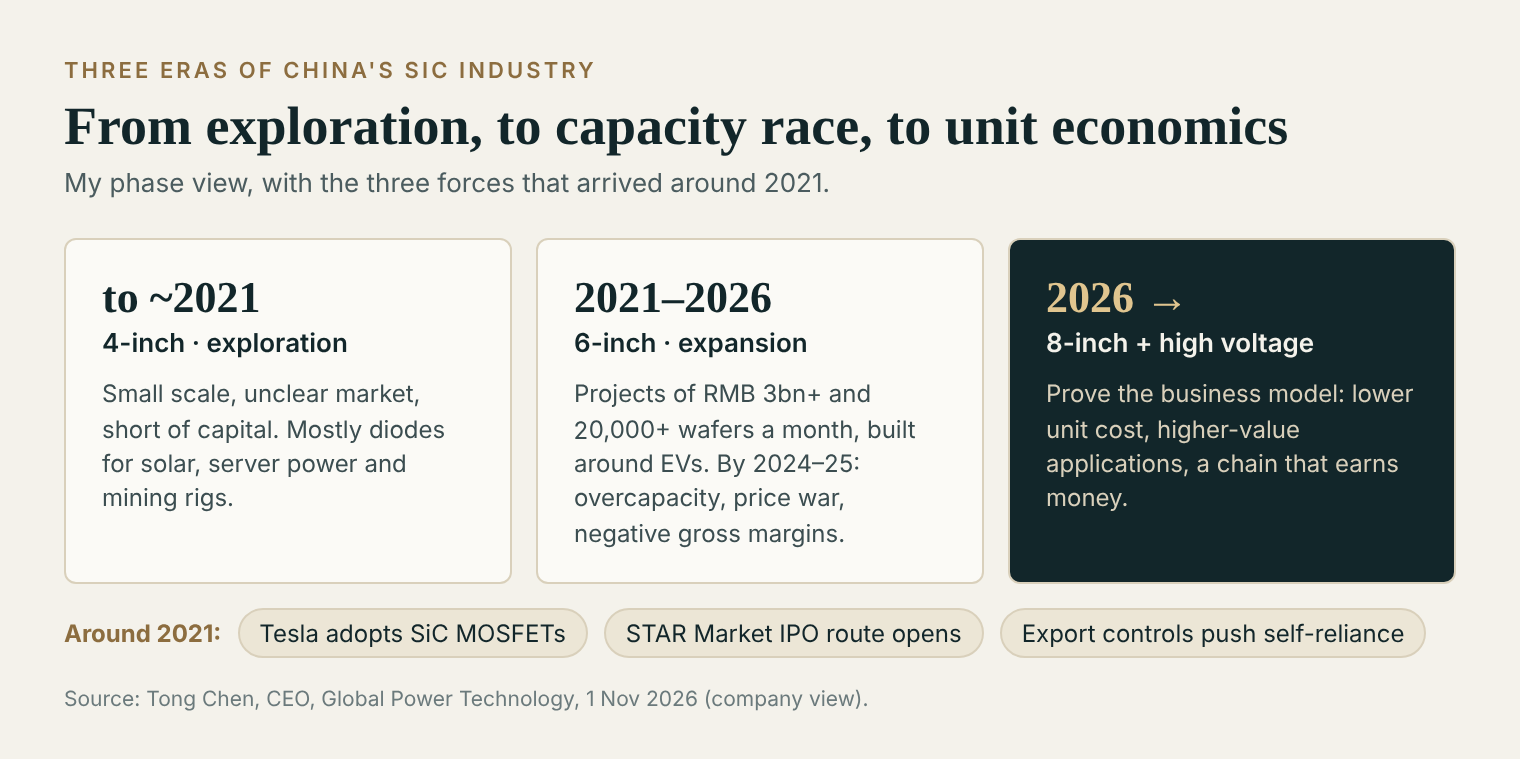
I see the industry in phases. Until about 2021 it was the 4-inch era: small, short of money, and unsure where the market was. Applications were mostly diodes in solar, server power and crypto-mining equipment. Global Power Technology, founded about fifteen years ago, spent its first decade building process know-how in that environment.
Around 2021, three forces arrived close together: Tesla's use of SiC MOSFETs in its vehicle traction inverters, the opening of the STAR Market IPO route for loss-making technology companies, and foreign export controls that made domestic supply a priority. Capital followed. A typical new project cost RMB 3 billion or more and planned 20,000+ wafers a month, with some running to RMB 10 billion, and most were designed around electric vehicles on 6-inch wafers.
By 2024–2025 that capacity had landed. China's substrate, epitaxy and wafer-fab capacities each exceed 2 million wafers a year. At the current technology level of 6-inch substrate material, supply exceeds demand, so everyone faces a market with no price floor, and large fabs are shipping at negative gross margin with no sign of profit in sight.
The arithmetic that was missing
The boom had a simple flaw. Many capacity plans multiplied EV sales by SiC content per car and built fabs to match. That assumes every EV needs SiC, and it does not. Neither electric vehicles nor industrial customers have to use SiC. If SiC is too expensive, they can stay with silicon IGBTs or redesign the system. Tesla's 2023 Investor Day statement that its next powertrain would use 75% less SiC without hurting performance or efficiency was a reminder: SiC performs very well, but cost remains the barrier to mass adoption.
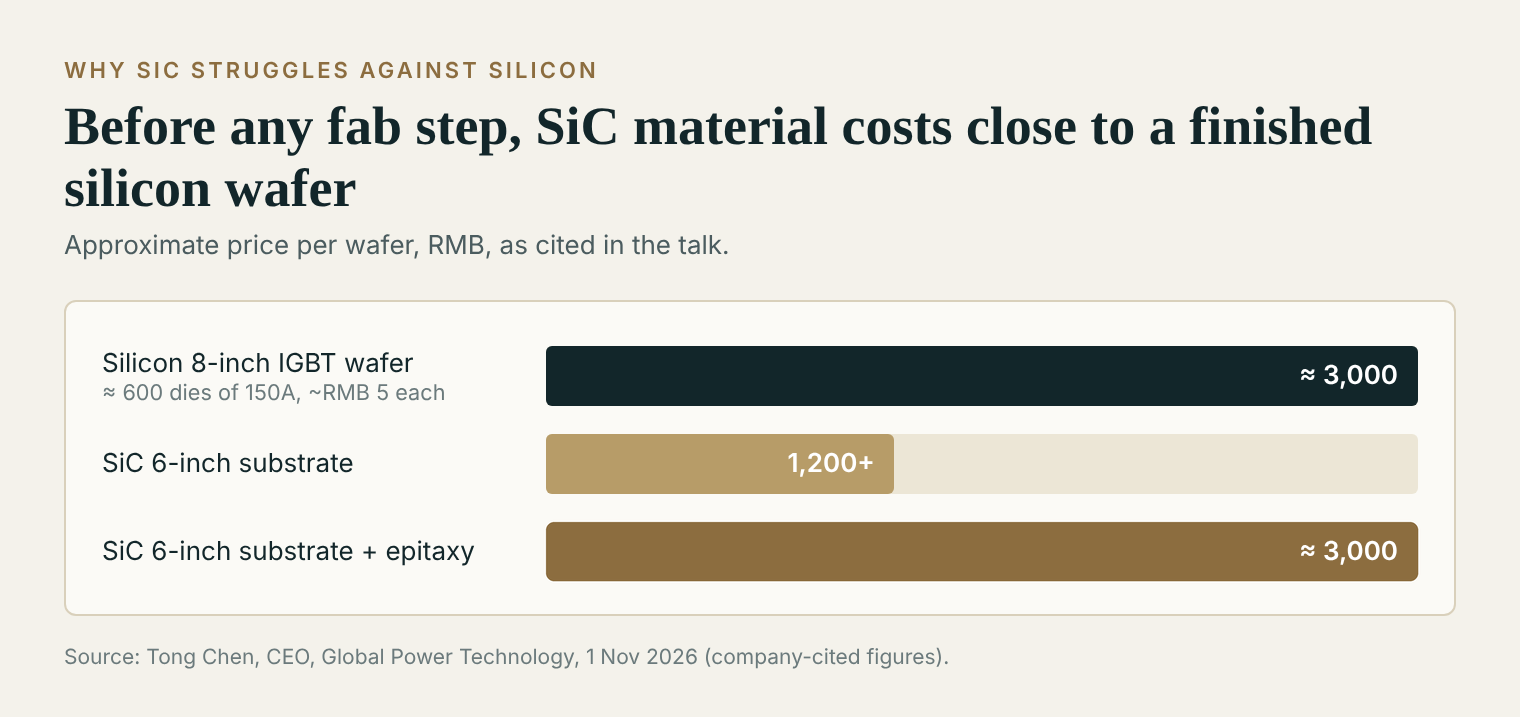
The silicon benchmark is unforgiving. A silicon 8-inch IGBT wafer sells for around RMB 3,000 and yields roughly 600 150A dies, about RMB 5 each. On the SiC side, a 6-inch substrate costs a little over RMB 1,000, and close to RMB 3,000 with epitaxy, before any wafer fabrication has started. Material alone approaches the price of a finished silicon wafer. The downstream industries, solar and EV, are also brutally competitive and demand constant price cuts, so there is little margin left for the wafer fab.
Heavy assets make it worse. A fab cannot be judged on processing revenue per wafer; depreciation, labor, utilities and maintenance sit on top, and a large fixed-cost base can keep a company loss-making even at respectable shipment volumes.
Moving to 8-inch wafers and targeting high-voltage applications
In 2024 we took two decisions: first, advance large-diameter SiC technology in small, fast steps; second, develop high-voltage MOSFETs together with application solutions. This restraint came at a cost. Investors and people inside the team pushed back while competitors committed billions, and we could not match that funding, nor did we want to accept years of heavy losses to buy sales volume at negative gross margin.
Our 8-inch project is still under construction, but our target economic model for the next two years is explicit:
| Item | Target |
|---|---|
| Substrate plus epitaxy | ≤ RMB 3,500 per wafer |
| Finished wafer shipment price | RMB 6,500 per wafer |
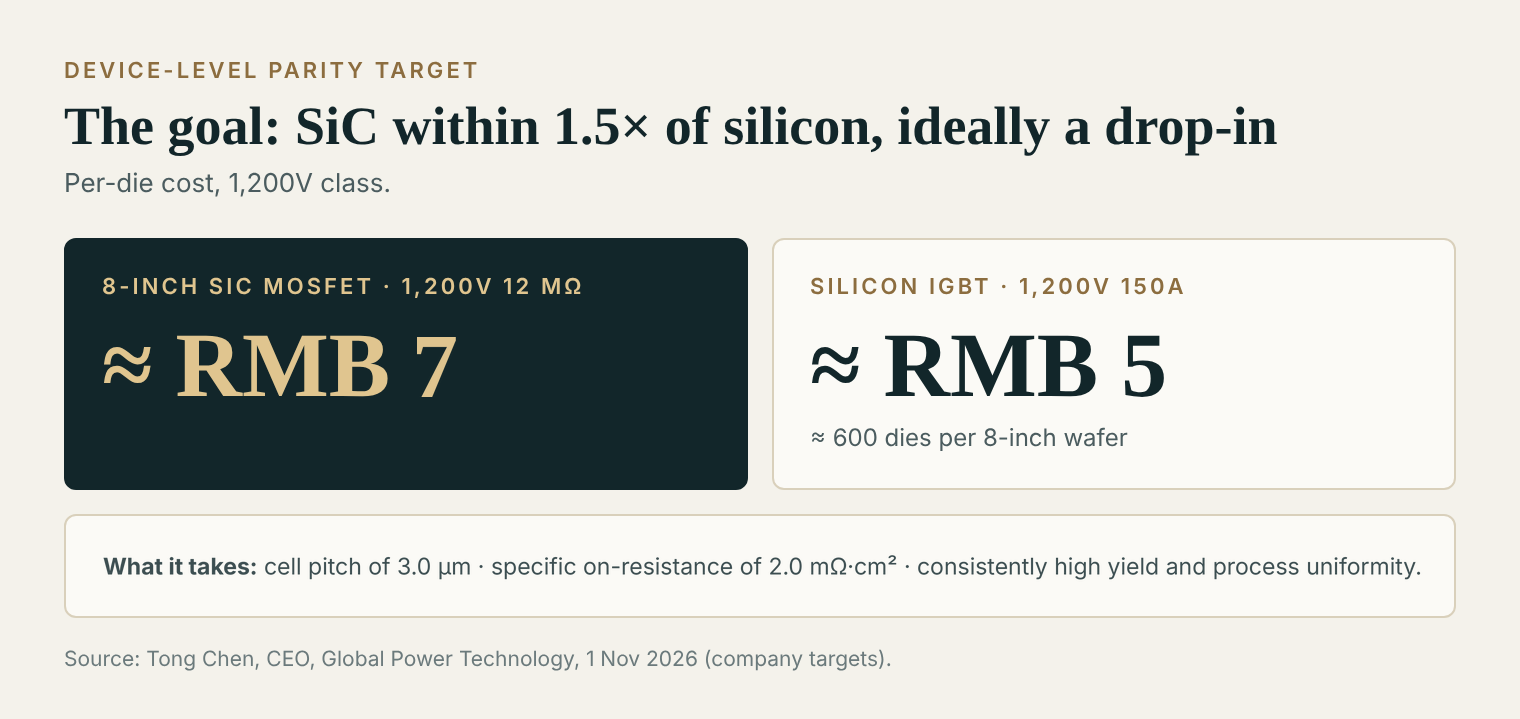
At the device level, the goal is price parity with the silicon IGBT. To get there, the SiC MOSFET design and process must reach a 3.0 µm cell pitch and a specific on-resistance of 2.0 mΩ·cm², and the line's yield control must be taken to the extreme so that high yield is sustained. SiC can charge a little more for its performance, but it is hard to sustain several times the price of silicon for long. I want it at no more than 1.5 times the price of the silicon device, ideally close to a drop-in replacement; that will be a necessary condition for domestic SiC to break through to a million wafers a year.
High voltage, where SiC is hard to replace
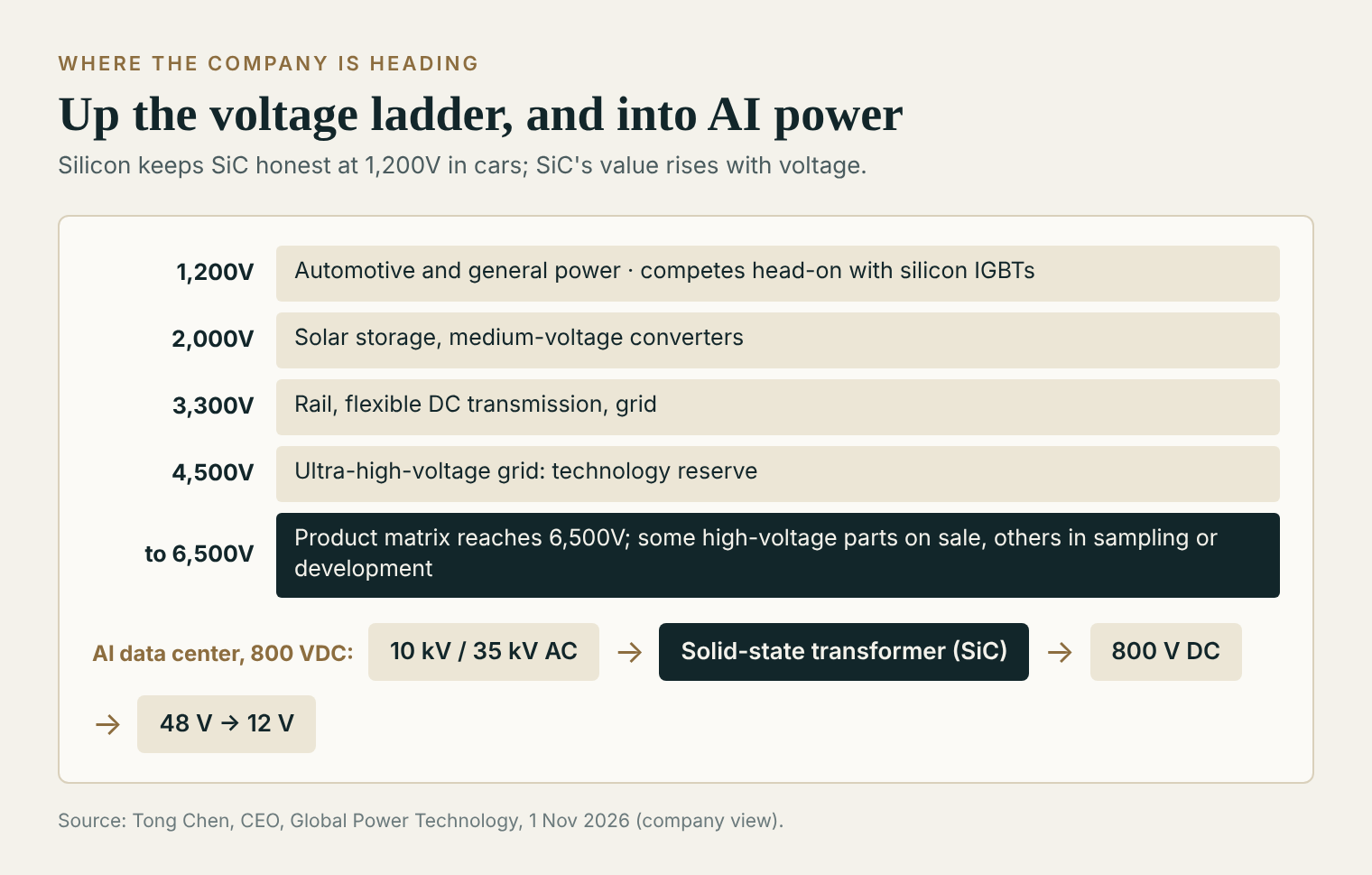
In 1,200V automotive, silicon keeps SiC honest on price. Higher voltages and frequencies are where SiC's physics matters most. Our MOSFET range now runs from 750V to 6,500V, and we showed wafer-level test curves for 2,000V (solar storage and medium-voltage converters), 3,300V (rail, flexible DC transmission and grid) and 4,500V (an ultra-high-voltage grid technology reserve). Some higher-voltage parts are on sale; others are still in sampling or development.
One caution, for ourselves as much as the industry: leading lab specifications are not the same as volume competitiveness, and reliability must not be traded for a headline number. Our 6-inch platform delivers yields above 90% and has passed demanding reliability qualification, with excellent stability of threshold voltage (Vth) and of junction-temperature characteristics.
The AI power opportunity
The growth case I believe in most strongly is AI data centers. A 2026 JPMorgan research note argues that AI servers' rising power draw forces the industry onto 800V DC architecture, reshaping power semiconductors across the grid, the rack and storage. In a solid-state transformer (SST) that converts 10 kV or 35 kV grid power to 800V DC, there is no role for silicon IGBTs; only SiC is feasible. Today's SSTs are held back by reliability and cost, and many are designed around imported 1,200V devices and modules. Domestic high-voltage, high-frequency SiC MOSFETs can solve both problems, and we want to work with domestic power and electrical equipment makers to redesign systems around higher-voltage devices, cutting complexity and improving the economics. In my view, AI's power ceiling is ultimately a silicon carbide question.
Profit across the whole value chain
For the industry to grow, we need more than cheap materials. Substrate and epitaxy suppliers must still earn a profit at our target prices, expand and keep supplying; otherwise material prices rebound and our business model fails. Our investment pace therefore has to match the maturity of substrate, epitaxy and device manufacturing together, because any link that expands too fast carries costs it cannot recover. Profit has to come from cost reduction across the chain, not from one link losing money. SiC should also not revolve around cars alone; the power grid is the next field.
Our roadmap has three phases: exploration from 2011 to 2021, 6-inch expansion from 2021 to 2026, and from 2026 a phase that relies on 8-inch wafers and high voltage to make SiC an industry that makes money. For the next three to five years the plan is to use our Beijing 8-inch line and high-voltage portfolio to enter applications such as solid-state transformers, and to turn years of technical accumulation into sustainable profit.