
From Science to Market: Why So Many Startups Fail to Move from Lab to Client
Turning scientific advances into industrial businesses is central to CM Venture Capital’s investment focus. This perspective explores the manufacturing, commercial, and financing challenges that founders must navigate—and why technical expertise needs to be paired with customer understanding and the right partners.

Every year, laboratories around the world announce breakthrough materials: cathodes that store more energy, solar films that are cheaper than silicon, coatings that repel water without chemicals. Every year, hundreds of startups are founded to turn those breakthroughs into products. Many attract considerable media attention. And every year, many fail — not because the science was wrong, but because the journey from lab to client is far longer, more expensive and more uncertain than the science alone ever suggested.
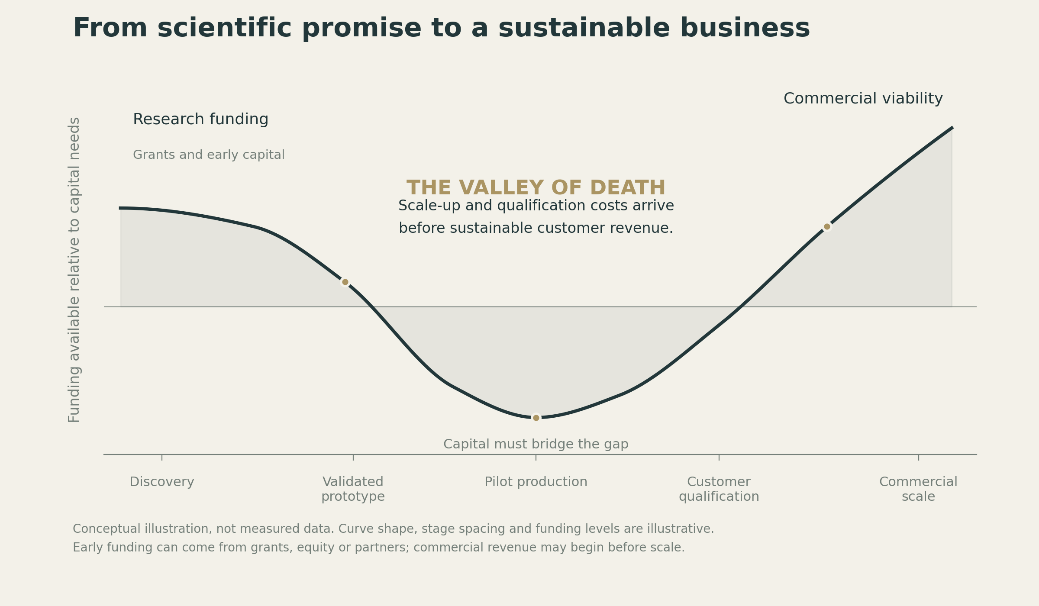
The literature on innovation has a name for this gap: the "valley of death," the stretch between a validated prototype and commercial viability, where public grants have run out but private investors, beyond friends and family circles, are not yet convinced.
It is where technically sound innovations collapse from resource depletion rather than technical failure. Nowhere is this valley deeper than in advanced materials, and the graveyard of new-materials startups offers some of the clearest lessons in modern deeptech entrepreneurship.
The physics of the problem: scale-up is not a bigger lab
The first trap is technical. A material that performs brilliantly in a five-gram sample often behaves differently at industrial scale. Yields, purity, defect rates, batch-to-batch consistency — none of these are "science" problems; they are chemical engineering, process control and quality management problems. A startup staffed by brilliant PhDs frequently discovers that its core competency stops at the pilot line.
Swiss-American battery maker Alevo is a textbook case. Backed by more than $160 million and a billion-dollar plan around a novel inorganic lithium-ion chemistry, the company bet on a huge factory in North Carolina before it had mastered production. In late 2017 it filed for bankruptcy, with its CFO citing "significant production challenges" and "insufficient revenue to continue operations." The assets sold for just over $9 million.
Konarka, which developed photoreactive polymer for PV films is another prime example of the difficulty of scaling a technology economically, despite raising some $300 million.
The economics of the problem: the incumbent is moving too
The second trap is market dynamics. A new material rarely competes against a static incumbent; it competes against an incumbent that is getting cheaper every quarter. This killed one of the most famous materials startups of all.
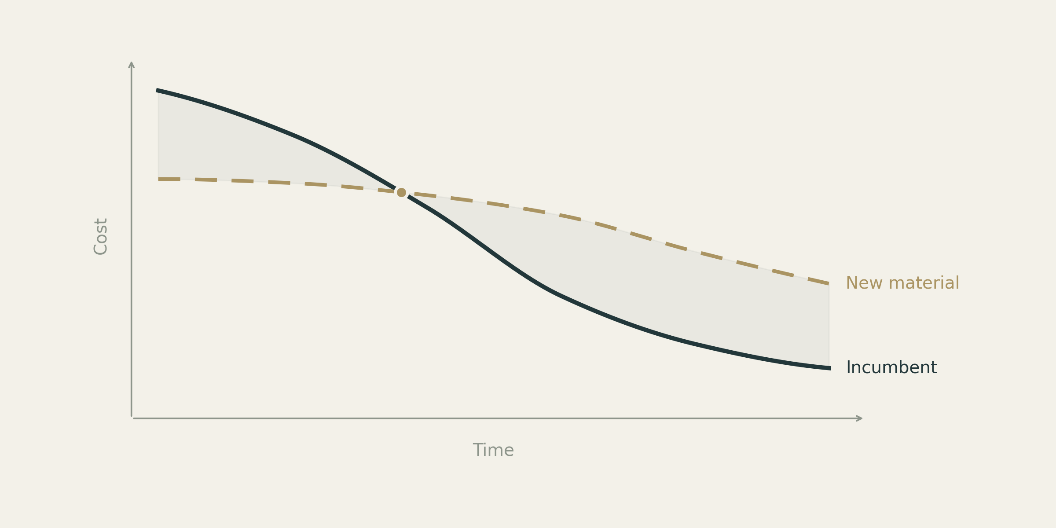
Solyndra's cylindrical CIGS thin-film solar panels were genuinely innovative — and when polysilicon prices spiked around 2005, its value proposition looked compelling, since CIGS does not require polysilicon at all. But the market responded to the polysilicon shortage by adding capacity, prices collapsed, and cheap crystalline silicon from massively subsidized Chinese manufacturers flooded the market. The company, which had received $535 million in federal loan guarantees, filed for bankruptcy in September 2011. The technology worked. The business case evaporated while the factory was being built.
The same pattern destroyed much of the CIGS industry — Nanosolar, HelioVolt, Soltecture, Odersun and many others exited the field. Aquion Energy, the saltwater-battery darling funded by Bill Gates and Kleiner Perkins, fell the same way: its aqueous hybrid batteries were safe and cheap, but lithium-ion costs kept falling, and it filed for Chapter 11 in 2017.
For advanced materials impacted by oil prices, the oil price volatility is also a major factor to consider. Biopolymers producers faced this reality the hard way in 2025 with ultra low oil-based virgin material prices.
The customer problem: materials are ingredients, not products
The third trap is commercial. A new material is an ingredient. Someone has to integrate it into a product, certify it, warranty it and stand behind it. Customers in energy, automotive and construction are conservative, slow and highly regulated — they demand lifetime performance data and compliance certifications exactly when the startup is struggling to complete its first deployments.
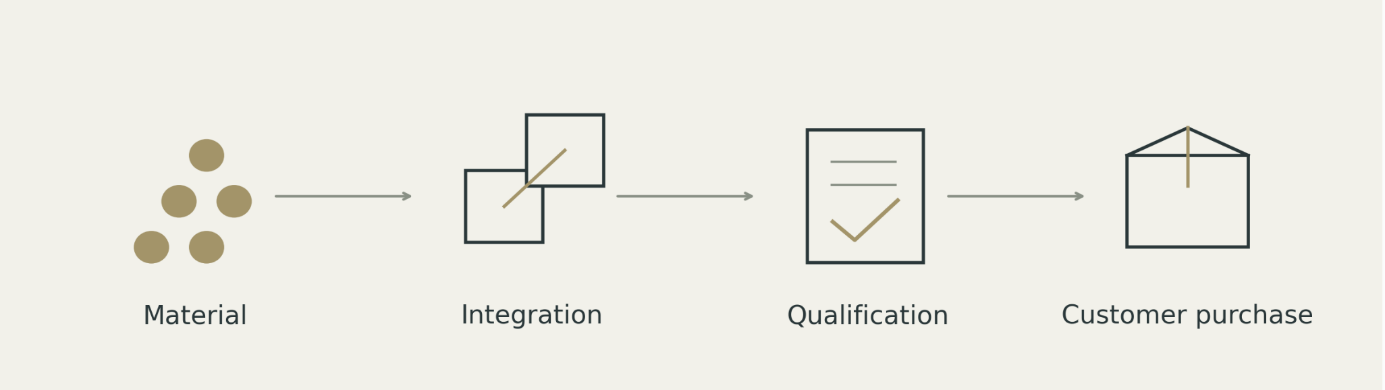
A software startup can sell a beta version; a battery startup cannot. MIT Technology Review counted the casualties in energy storage — A123 Systems, Alevo, Ambri, Aquion, EnerVault, LightSail - and identified the same root causes: high manufacturing costs, strong incumbents, technical challenges and slow adoption of new technologies.
Part of the commercial trap is also about solving the wrong customer problem. I personally spent months promoting a high performance adhesive at a large automotive tier one supplier, only to realize that the number one issue of the customer, and of the market as a matter of fact, was product processability, not performance in the finished product. Only by visiting the shopfloor did the problem that the customer did not perceive become apparent.
And yes, collaborating wtih blue-chip companies can look impressive fancy in the eyes of many, but a sales contract with a midsize company may be more valuable in sharing technical progress than an MoU with a multinational conglomerate. The same applies on the supplier side.
What crossing the valley looks like
From my experience, the failures converge on a few recurring causes: capital depletion before sustainable revenue, market validation that never materializes at the predicted rate, and commercial teams that lack enterprise sales capability. The survivors, by contrast, tend to share a handful of traits:
- Sell the product, not the material. The most successful materials startups deliver a finished component or system, so the customer does not have to become a materials engineer to get the expected performance.
- Find a beachhead market — a niche where the material's specific properties command a premium, rather than competing head-on with the incumbent on price. For that, knowing the industrial processes of targeted customers and markets is key.
- Co-develop with anchor customers who share the certification burden and validate the technology with early deployments.
- Match capital to the timeline: strategic corporate investors and milestone-based partnerships or material science / impact focused VC, rather than classic VC alone, survive the long scale-up.
- Time the market honestly. Solyndra's real mistake was not the technology; it was betting that polysilicon prices would stay high. Assumptions about the incumbent's cost curve and their ability to move along that curve deserve as much rigor as the materials science. Do not limit the market analysis to today’s situation.
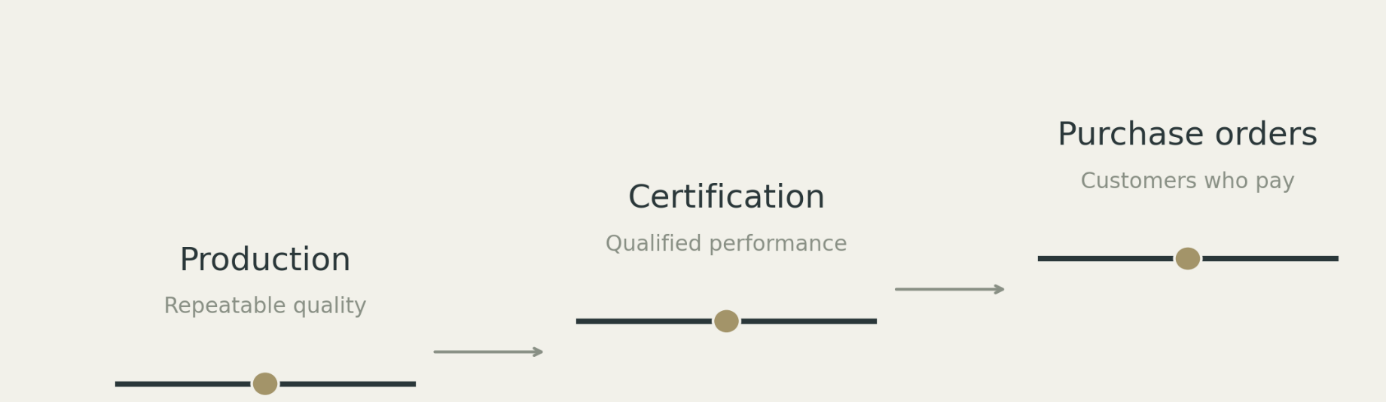
The distance from lab to client is not measured in publications or MoUs but in running production lines, in certifications granted, and purchase orders.
Solyndra, Alevo, Aquion and their peers did not fail because their materials did not work. They failed because a working material in a lab is only the entrance ticket to a much longer game — one of process scale-up, patient capital, and customers who buy reliability and cost effectiveness, not novelty.
For the next generation of materials startups, the lesson is humbling but liberating: the science gets you to the starting line, and success after that depends on engineering, economics, customers’ buy-in, and the right syndicate of investors to play the long game and facilitate critical connections.